




UGC ad creative outperforms polished brand content on Facebook cold traffic because it matches the native look of the feed. For Shopify and WooCommerce brands running Facebook ads, the right UGC ad creative format depends on placement: feed, Reels, and Stories each reward different structures, ratios, and lengths. Getting the format wrong wastes the asset regardless of how good the content is.
This guide covers which UGC ad creative formats convert on Facebook by placement, how to structure a hook that stops the scroll, what aspect ratios to brief your creators on, and how to test UGC ad creative so you know what to scale. For Instagram-specific UGC creative, see our guide to Instagram ad creative strategy for ecommerce.
Is your Facebook UGC ad creative actually converting?
AI Advantage Agency builds and manages paid media programs for SMB ecommerce brands. We handle UGC creative strategy, format testing, and scaling what works.
The Quick Take: UGC Ad Creative on Facebook by Placement
| Facebook Placement | Best UGC Ad Creative Format |
|---|---|
| Feed (desktop and mobile) | Raw testimonial or demo, square or landscape ratio, 15-45 seconds, problem-solution structure |
| Facebook Reels | Hook-first vertical video, 9:16, under 30 seconds, native creator style with trending audio |
| Stories | Vertical 9:16, fast-paced, 6-15 seconds, single benefit focus with direct CTA |
| Advantage+ placements | Multiple UGC ad creative variants fed simultaneously; algorithm selects format per placement |
The Takeaway: Facebook feed rewards longer problem-solution UGC while Reels and Stories reward shorter hook-first formats. Briefing creators for one ratio and repurposing across all placements without adaptation leaves performance on the table.
💡 Pro Tip: Always brief creators to film in 9:16 vertical as their primary deliverable. You can crop vertical to square or 4:5 for feed without losing the subject. You cannot crop landscape to vertical. One vertical shoot gives you feed, Reels, and Stories assets. One landscape shoot gives you feed only.
Table of Contents
→ UGC Ad Creative Formats for Facebook Feed
→ UGC Ad Creative for Facebook Reels and Stories
→ How to Structure a UGC Hook for Facebook Ads
→ Aspect Ratios and Specs for Facebook UGC Ad Creative
→ How UGC Ad Creative Works in Advantage+ Campaigns
→ How to Test UGC Ad Creative on Facebook
→ The Bottom Line on UGC Ad Creative for Facebook
→ FAQ: Common Questions About Facebook UGC Ad Creative
UGC Ad Creative Formats for Facebook Feed
Facebook feed rewards UGC ad creative that follows a problem-solution structure with a strong first frame. Feed placements run in a scrolling environment where the first visual or spoken word either earns attention or loses it. UGC ad creative that opens mid-sentence, mid-action, or mid-demonstration performs better than content that starts with an introduction or brand name.
The four UGC ad creative formats that convert on Facebook feed are raw testimonials, unboxing videos, demo clips, and hook-first talking head videos. Raw testimonials feature a creator speaking directly to camera about a product in a conversational tone. They work best for products that solve a specific, relatable problem. Unboxing videos open with the product arriving and follow the creator through first use. They work well for products where packaging and presentation add perceived value.
Demo clips show the product in use in a real environment. They convert well for products with a clear before-and-after or a use case that is not immediately obvious from a static image. Hook-first talking head videos open with a bold, specific claim or question and build toward a product reveal. This format works across almost every product category and is the easiest format to test hook variations on because the product footage stays constant while only the opening changes.
💡 Pro Tip: Facebook feed allows longer UGC ad creative than most brands assume. Videos up to 45 seconds can outperform 15-second clips when the product has a meaningful story to tell and the hook earns the watch time. Test both lengths before defaulting to short. The right length is determined by your data, not platform convention.
UGC Ad Creative for Facebook Reels and Stories
Facebook Reels and Stories demand shorter, faster UGC ad creative than feed placements because the viewing context is different. Reels viewers scroll vertically through a dedicated content stream and make skip decisions in under one second. Stories viewers tap through sequentially. Both formats reward UGC ad creative that feels indistinguishable from organic creator content on those surfaces.
For Reels, brief creators to open with movement, a bold verbal hook, or an unexpected visual in the first half-second. Trending audio helps Reels UGC ad creative blend into the organic feed. Keep the total length under 30 seconds. The Meta Reels ad specs recommend 9:16 ratio with a safe zone that keeps key visuals and text away from the top and bottom 14% of the frame to avoid UI overlay conflicts.
For Stories, UGC ad creative performs best at 6 to 15 seconds with a single benefit focus and a direct CTA in the final frame. Stories UGC ad creative does not need the same narrative arc as feed content. One problem, one product, one CTA. Anything more complex loses the viewer before the message lands. For a broader look at how UGC fits into the full Facebook ads strategy for ecommerce, see our guide to Facebook ads for ecommerce.
💡 Pro Tip: Reels UGC ad creative that uses trending audio performs better organically but can create licensing complications when running as a paid ad. Brief creators to film with original audio or royalty-free music only. Meta’s Ads Manager will flag licensed music in paid placements and may limit distribution. Confirm audio rights before the shoot, not after the footage arrives.
How to Structure a UGC Hook for Facebook Ads
The hook is the most important element of any UGC ad creative on Facebook because it determines whether a viewer watches or scrolls. A strong hook does one of three things in the first two seconds: names a specific problem the viewer recognizes, makes a bold claim they want to verify, or shows something visually unexpected that earns a second look. Generic hooks like “I found this amazing product” do none of these things and perform accordingly.
The most reliable UGC hook structure for Facebook ad creative follows three parts: Problem, Credibility, and CTA. The Problem names the pain point in the first two seconds. The Credibility section shows the product solving that problem through demonstration, not description. The CTA closes with one clear action that matches the landing page offer.
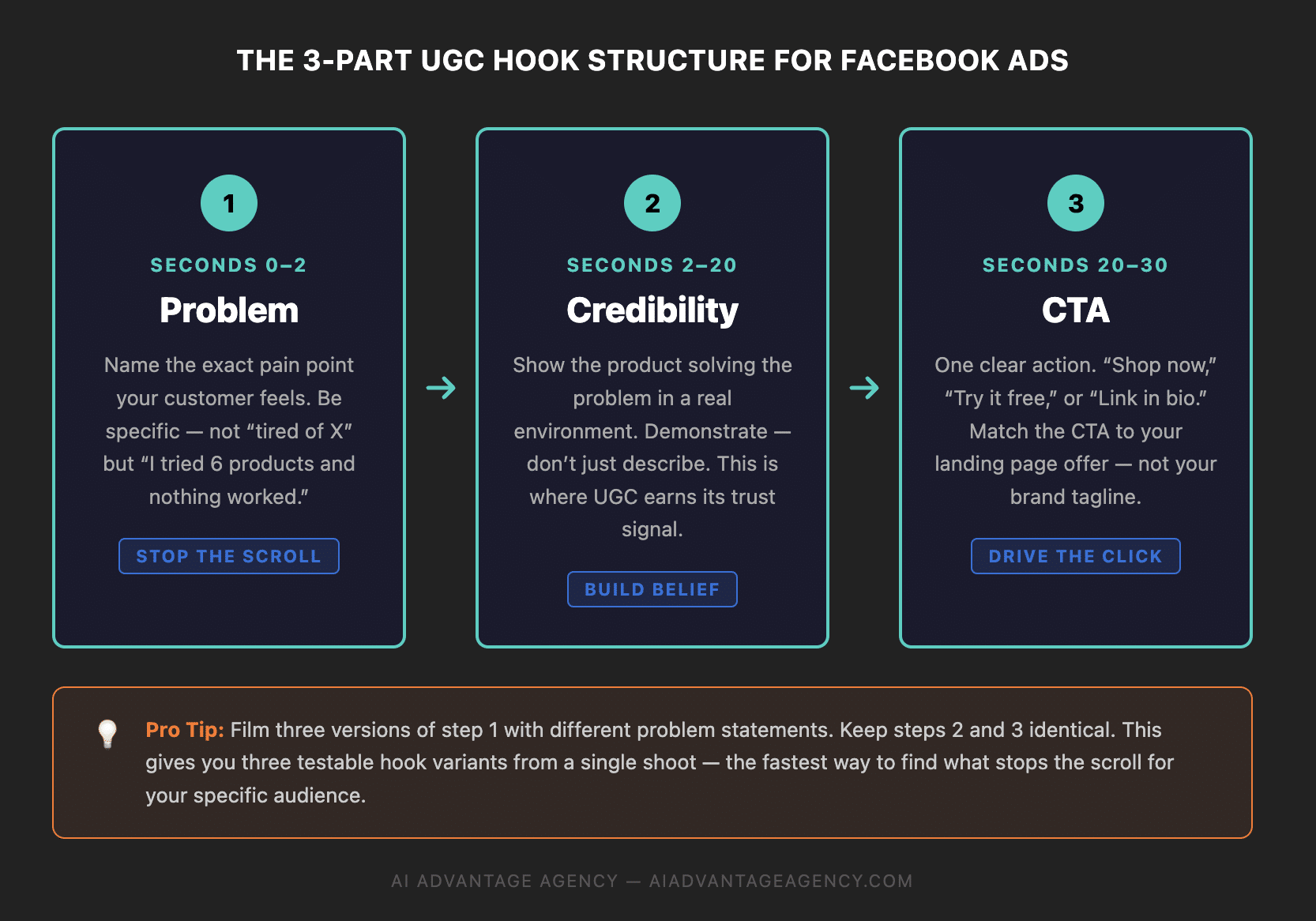
💡 Pro Tip: Commission three versions of every UGC asset with different hooks and identical middle and end sections. This isolates the hook as the test variable and gives your media buyer three distinct ads from one shoot. Hook testing is the highest-leverage creative test you can run on Facebook because hook performance drives thumb-stop rate, which drives cost per click, which drives overall campaign efficiency.
Aspect Ratios and Specs for Facebook UGC Ad Creative
Briefing creators with the correct aspect ratio before they film prevents the most common and most expensive UGC production mistake: unusable footage. Creators who film in landscape on a horizontal camera setup cannot deliver vertical assets without reframing, which often means a reshoot. Getting the ratio right in the brief costs nothing. Getting it wrong after the fact costs time and money.
| Placement | Ratio and Spec |
|---|---|
| Facebook Feed (mobile) | 4:5 portrait or 1:1 square, minimum 1080x1080px, up to 241 minutes |
| Facebook Feed (desktop) | 16:9 landscape or 1:1 square, minimum 1280x720px |
| Facebook Reels | 9:16 vertical only, minimum 500x888px, recommended 1080x1920px, under 90 seconds |
| Facebook Stories | 9:16 vertical only, minimum 500x888px, recommended 1080x1920px, under 60 seconds |
💡 Pro Tip: Brief all creators to film 9:16 vertical at 1080x1920px as the default deliverable for all UGC ad creative. From vertical footage, your editor can export 4:5 by cropping the top and bottom, and 1:1 by cropping to center. You cannot go the other direction. One vertical brief covers every Facebook placement and every Meta surface, including Instagram.
How UGC Ad Creative Works in Advantage+ Campaigns
Meta Advantage+ Shopping Campaigns perform best when you feed them a minimum of five to eight UGC ad creative variants simultaneously. Advantage+ uses machine learning to match creative variants to the audience segments and placements where each performs best. The algorithm needs creative volume to optimize. Brands that enter Advantage+ with one or two assets give the system nowhere to go.
UGC ad creative is particularly well-suited to Advantage+ because the format variety maps to placement variety. A raw testimonial in 4:5 ratio serves feed placements. A hook-first 9:16 clip serves Reels. A 10-second Stories cut serves Stories. When you upload these as separate assets inside one Advantage+ campaign, Meta routes each creative to the placement where it performs best without requiring you to set up separate ad sets. For a full breakdown of how Advantage+ campaigns work for ecommerce, see our guide to Meta Advantage+ campaigns.
The most common Advantage+ mistake with UGC ad creative is uploading assets without verifying that each placement has at least one correctly-sized variant. If you upload only 9:16 vertical assets, Advantage+ will run them in feed placements at a cropped ratio that may cut off key visuals. Upload at least one asset per placement ratio to give the algorithm clean options for every surface.
💡 Pro Tip: Name your UGC ad creative assets descriptively before uploading to Advantage+. Use a naming convention that includes the format type, ratio, and hook variant: for example “testimonial-45-hook1” or “unboxing-916-v2.” When the algorithm identifies a winning creative, you need to know exactly what brief produced it so you can commission more like it.
How to Test UGC Ad Creative on Facebook
Testing UGC ad creative on Facebook requires isolating one variable per test so you know what drove the result. Most brands launch multiple new UGC assets at once with no test structure and end up with data that cannot tell them whether the hook, the format, the creator, or the offer drove performance. A structured test answers one question at a time.
Start with hook testing. Take one piece of UGC ad creative and produce three versions with different opening hooks. Keep everything else identical: the product footage, the CTA, the creator, the ratio. Run all three at equal budget with identical targeting for seven days minimum. The hook with the lowest cost per click and highest 3-second video view rate becomes your control. Use Meta’s A/B test tool in Ads Manager to run statistically valid creative comparisons without manually splitting audiences.
After you identify a winning hook, test UGC ad creative format. Pit the winning hook in testimonial format against the same hook in demo format. Then test creator variables: age, tone, environment, and on-camera style. Each test builds on the last. Within four to six weeks of structured testing, most Shopify and WooCommerce brands have a clear picture of which UGC ad creative profile drives the best results for their specific product and audience. For the full testing framework, see our guide to UGC testing for ecommerce.
💡 Pro Tip: Set a minimum spend threshold before reading test results. On Facebook, most UGC ad creative tests need at least 50 purchase events per variant to reach statistical significance. On a $40 CPA that means $2,000 per variant before the data is reliable. Calling tests early based on click data alone routinely produces wrong conclusions. Let purchase data accumulate before making scale decisions.
The Bottom Line on UGC Ad Creative for Facebook
UGC ad creative is the highest-converting format for Facebook cold traffic when it is briefed, produced, and tested correctly. The format that converts depends on the placement. The hook determines whether the ad earns attention. The structure determines whether it converts. And the testing framework determines whether you scale the right assets or waste budget on the wrong ones.
The brands that build a durable UGC ad creative advantage on Facebook treat format, ratio, and hook as distinct variables they test systematically. They brief creators with placement specs before the shoot. They request raw footage so they can cut multiple variants from one shoot. They run structured hook tests before scaling any asset. This process is repeatable for every product, every campaign, and every audience segment.
Start by auditing your current Facebook UGC ad creative against the placement specs in this guide. If your existing assets are in the wrong ratio for the placements they are running in, that is the first fix. Everything else builds from there. For the full UGC ads picture, visit the main guide to UGC ads for ecommerce.
🎯 Ready to Build Facebook UGC Ad Creative That Actually Scales?
AI Advantage Agency manages paid media for SMB ecommerce brands, including UGC creative strategy, format testing, and Advantage+ campaign management. We build the system and scale what the data tells us to.
No account access required. We review your current UGC creative mix and tell you exactly what to test next.
Frequently Asked Questions About UGC Ad Creative for Facebook
What UGC ad creative format works best on Facebook?
Raw testimonials and demo videos in square or 4:5 ratio perform best on Facebook feed. Hook-first vertical videos in 9:16 perform best on Facebook Reels. Short single-benefit clips under 15 seconds work best for Stories. The right format depends on the placement.
What aspect ratio should UGC ad creative be for Facebook?
Brief creators to film in 9:16 vertical at 1080x1920px as the default. From vertical footage you can export 4:5 for feed and 1:1 for square placements. Facebook Reels and Stories require 9:16. Facebook feed accepts 4:5, 1:1, and 16:9.
How long should UGC ad creative be for Facebook ads?
Facebook feed UGC ad creative can run 15 to 45 seconds for problem-solution formats. Facebook Reels should stay under 30 seconds. Stories should run 6 to 15 seconds. Test both shorter and longer versions for feed before defaulting to one length.
What is the best hook structure for UGC Facebook ads?
The most reliable UGC hook structure for Facebook is Problem, Credibility, CTA. The first two seconds name the customer’s specific pain point. The middle section shows the product solving that problem through demonstration. The final section delivers one clear call to action that matches the landing page offer.
How does UGC ad creative work in Meta Advantage+ campaigns?
Meta Advantage+ performs best with five to eight UGC ad creative variants uploaded simultaneously. The algorithm routes each creative to the placement and audience where it performs best. Upload at least one correctly-sized asset per placement ratio to give Advantage+ clean options for every surface.
How do I test UGC ad creative on Facebook?
Start with hook testing. Create three versions of one UGC asset with different opening hooks and keep everything else identical. Run all three at equal budget for seven days minimum using Meta’s A/B test tool. The hook with the lowest cost per click and highest 3-second view rate becomes your control for the next test.
Should I use the same UGC ad creative on Facebook and Instagram?
You can run the same UGC asset across Facebook and Instagram placements in Advantage+ and let the algorithm optimize. However, creative briefed specifically for each platform’s native format will outperform repurposed assets. Instagram Reels rewards faster pacing and trending audio more than Facebook feed does.
What makes UGC ad creative different from brand creative on Facebook?
UGC ad creative looks like content filmed by a real person on their phone. Brand creative looks like a produced advertisement. On Facebook cold traffic, UGC ad creative outperforms brand creative because it matches the native look of the feed and does not trigger the visual pattern recognition that causes users to scroll past obvious ads.
How many UGC ad creative variants do I need for Facebook?
Start with five variants: three hook variations of one core concept and two format variations. This gives you enough creative to run a structured hook test and a format test. For Advantage+ campaigns, aim for eight or more variants so the algorithm has enough material to optimize across placements.
Do I need separate UGC ad creative for Facebook Reels vs feed?
Yes. Facebook feed rewards longer problem-solution formats in square or 4:5 ratio. Facebook Reels rewards shorter hook-first vertical video under 30 seconds in 9:16 ratio. Briefing creators to film vertical gives you assets that work across both placements with minimal editing.
