



AEO vs GEO is the defining AI search question for marketers in 2026, and the brands that treat them as competing options are already losing ground. Answer Engine Optimization (AEO) secures your content in zero-click answers and voice results. Generative Engine Optimization (GEO) earns your brand citations inside the conversational AI responses that now influence buying decisions before a user ever visits your site. You need both, but you do not start both at the same time.
This guide gives you the framework to decide where to start, how to sequence your efforts, and how to build the kind of AI visibility that compounds over time in what we call the Intervention Economy, where AI agents recommend brands before humans even search.
Want us to build your AEO and GEO strategy?
We handle the schema, content structure, and entity signals so your brand gets cited by ChatGPT, Perplexity, and Google AI Overviews.
The Quick Take
| AEO (Answer Engine Optimization) | GEO (Generative Engine Optimization) |
|---|---|
| Goal: Win the direct, zero-click answer | Goal: Earn citations in AI-generated responses |
| Content style: Concise, factual, answer-first | Content style: Deep, authoritative, context-rich |
| Key platforms: Voice search, Siri, featured snippets, AI Overviews | Key platforms: ChatGPT, Gemini, Perplexity, AI Overviews |
| Success metric: Snippet appearances and voice citations | Success metric: Frequency of brand mentions in AI responses |
| Timeline: Results visible in 30–60 days | Timeline: Authority builds over 60–120 days |
Bottom line: AEO gets you found. GEO gets you trusted. In 2026, you need both to stay visible as AI engines replace the first page of search results.
💡 Pro Tip: If you are only tracking keyword rankings, you are measuring the wrong thing. The new visibility metric is how often AI engines cite your brand when a prospect asks a question you should own. Start tracking your AI citation frequency alongside traditional rankings.
Table of Contents
→ Why the Search Landscape Is Shifting Toward AI-Driven Answers
→ Why SEO Is Still the Foundation (And Why That Makes AEO and GEO Possible)
→ What Defines the Technical Core of AEO?
→ How Does GEO Build Long-Term Entity Trust?
→ Why Technical Speed Is the Entrance Fee for AI Visibility
→ Which Should You Prioritize? A Decision Framework by Business Type
→ The Bottom Line on AEO vs GEO
→ FAQ: Common Questions About AEO vs GEO
Why Is the Search Landscape Shifting Toward AI-Driven Answers?
Traditional SEO focused on ranking a list of blue links. The new focus is on becoming the definitive answer for the AI systems that now sit between a user’s question and your website. At AI Advantage Agency, we identified AEO and GEO as the two pillars of this new search era before most agencies acknowledged it was happening.
The scale of this shift is no longer theoretical. 25% of Google searches now trigger an AI Overview result, according to the Conductor 2026 Benchmarks Report, and that number runs higher in competitive B2B categories. When AI Overviews appear, they absorb clicks that previously went to the top organic results. The brands that earn a citation inside those AI responses win. The brands that only optimize for the link below lose volume they may never recover.
The debate over AEO vs GEO strategy often misses the core point: these are not competing tactics. They serve different roles in your AI search ecosystem, and understanding the difference is what lets you sequence them correctly instead of spreading your resources thin across both simultaneously.
Why SEO Is Still the Foundation (And Why That Makes AEO and GEO Possible)
SEO is the floor, not the ceiling. Without traditional search visibility, neither AEO nor GEO can perform. AI engines index the same web that Google crawls. If your content does not rank, AI systems cannot cite it with confidence, because low-authority pages do not carry the trust signals that generative models use to select sources.
Organic traffic still dominates discovery even in AI-heavy industries, per Conductor’s 2026 data. AI Overviews do not replace organic results. They appear above them. A brand that ranks on page two cannot earn consistent AI Overview citations. The new hierarchy works in layers: SEO earns you visibility, AEO makes your content extractable, and GEO makes your brand the authority that AI engines recommend.
Think of it this way: if SEO gets you in the room, AEO gets you the quote, and GEO gets you the recommendation. All three depend on each other. Skipping the foundation to chase AI citations is the fastest way to build on sand.
What Defines the Technical Core of AEO?
AEO is the process of making your content mechanically extractable by AI engines. It targets voice assistants, featured snippets, and AI Overviews by structuring content around a single, factual response to a specific question. The goal is not to be the most comprehensive page; it is to be the most parseable one.
Your machine-readable schema strategy is the foundation of AEO. Without structured data, AI engines cannot verify the facts of your business or confidently attribute answers to your brand. Schema markup is how you tell the machine what you are, what you do, and why you are the authoritative source. Visit our Schema for AEO guide for the specific markup types that drive AI citations.
AEO Execution: What to Implement First
These five tactics produce the fastest AEO results for most brands:
- Structure content as one question per section: use the question as your H2 heading and answer it in the first 40 to 60 words of the section body.
- Implement FAQ schema and Article schema on every content page. These are the two markup types AI engines reference most for snippet extraction.
- Keep answer blocks under 50 words for voice search extraction. Voice assistants pull short, declarative answers, not paragraphs.
- Maintain consistent NAP and entity data across your site: your name, address, phone number, and business category must match exactly across every page and directory listing.
- Prioritize page speed. AI crawlers deprioritize slow sites. If the machine cannot parse your content efficiently, your structured data does not matter. (More on this in the speed section below.)
💡 Pro Tip: AEO improvements show measurable results in 30–60 days because they operate at the technical layer, not the authority layer. Start here if you want early wins while your GEO strategy builds momentum in the background.
🚀 Not Sure Where Your AEO Strategy Stands?
Our free AEO audit tool analyzes your site’s extractability and schema coverage in minutes. See exactly what AI engines see when they crawl your content.
No login required. Results in under two minutes.
How Does GEO Build Long-Term Entity Trust?
GEO is the strategy of becoming a trusted reference inside a conversational AI response. When ChatGPT, Gemini, or Perplexity synthesizes a complex answer for a user, GEO determines whether your brand is the source it cites. This is the Intervention Economy in action: AI agents make brand recommendations before users even frame a search query.
The foundational GEO signals are three: unique, verifiable data that AI models can reference; consistent entity identity across every platform where your brand appears; and original research that other authoritative sources link to and cite. These three signals build what generative models recognize as entity trust.
The Offsite Trust Layer: What Most Brands Skip
Onsite content is only half the GEO equation. LLMs weight external sources heavily when selecting citation sources, a principle that Microsoft’s AEO/GEO guidance formalizes as a core ranking signal. Building offsite trust means earning editorial mentions in industry publications, maintaining accurate listings on review platforms and third-party directories, and generating genuine references in other authoritative content.
Brand identity consistency matters here more than most marketers expect. If your brand name, description, and category vary across your website, Google Business Profile, LinkedIn, and industry directories, AI engines treat you as a less reliable entity. Consistent identity across the web is how machines recognize you as a single, trustworthy source rather than several loosely related references.
How Long Does GEO Take to Show Results?
GEO authority builds more slowly than AEO because it depends on external signals, not just onsite technical changes. Set realistic expectations: AEO improvements become visible in 30–60 days, while GEO authority signals take 60–120 days to build meaningfully. This is not a weakness of the strategy. It is a moat. The brands that start GEO now will have a 90-day head start on every competitor who waits until it becomes obvious. Explore our full Generative Engine Optimization strategy for the complete GEO framework.
💡 Pro Tip: Track your GEO progress by running weekly queries in ChatGPT, Perplexity, and Gemini for the questions your ideal clients ask. Note when your brand starts appearing in responses. This is your real-world citation frequency benchmark, and it tells you more than any keyword ranking report.
Why Is Technical Speed the Entrance Fee for AI Visibility?
You cannot earn AI citations if the crawlers cannot reach your content. Modern answer engines prioritize speed and crawl efficiency above almost every other technical signal. Fast crawlability is what makes AEO possible in the first place: if an AI agent cannot parse your site in milliseconds, your structured data never gets evaluated.
At AI Advantage Agency, we audited our own infrastructure against these standards and achieved a 244ms load time, placing our site in the top 1% of agency sites. This was not cosmetic. Sites that load in more than two seconds face consistent deprioritization by generative engines in favor of faster, more reliable sources.
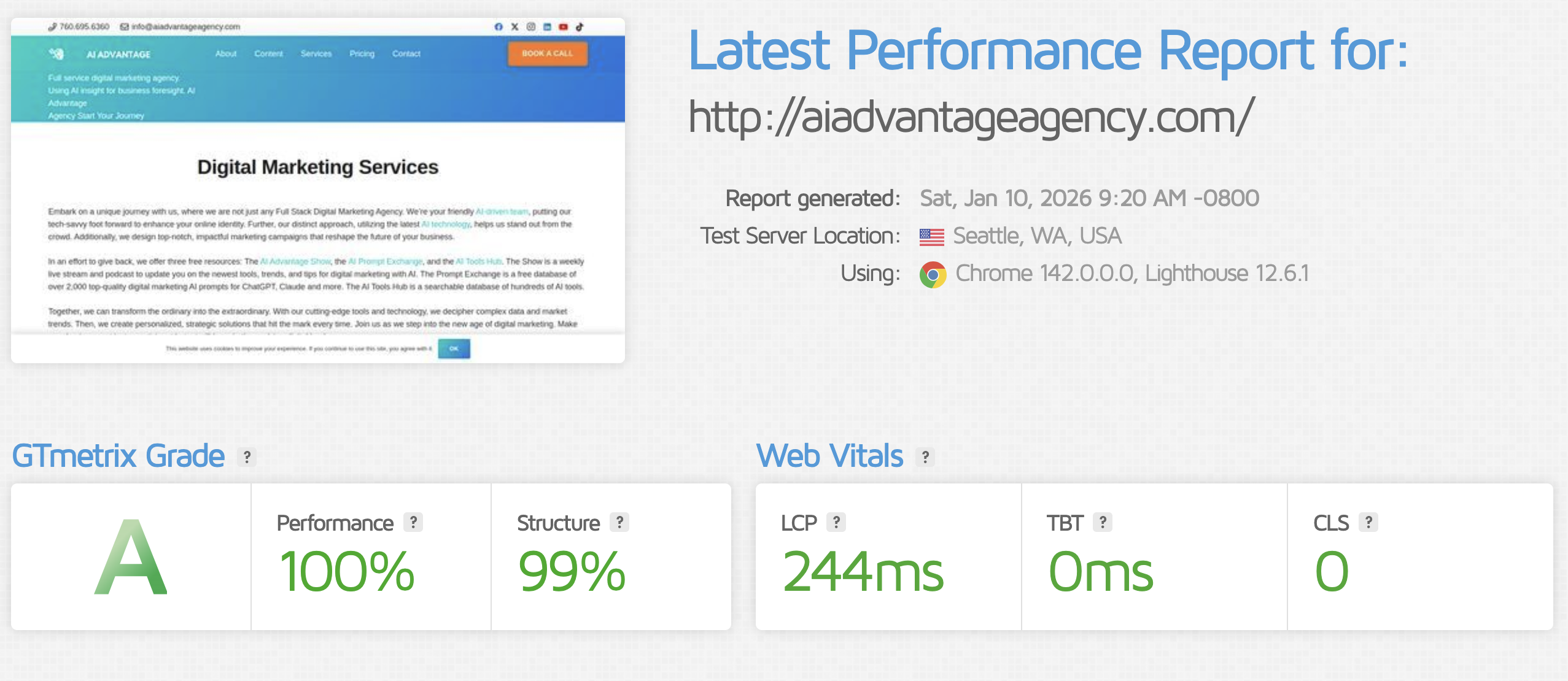
Our GTmetrix audit confirms a 244ms load time, placing our infrastructure in the top 1% of agency sites globally.
Speed also signals to generative engines that your site operates with the reliability expected of an authoritative source. A slow site is not just a user experience problem. It is a machine-trust problem. Every second of load time is a reason for an AI engine to cite your competitor instead of you.
Which Should You Prioritize? A Decision Framework by Business Type
The right starting point depends on where you are, not where you want to be. Most brands make the mistake of trying to run AEO and GEO simultaneously at full intensity, spreading resources thin and seeing slow results from both. A sequenced approach gets you faster wins and builds a stronger compounding foundation.
| If You Are… | Start With / Then Build |
|---|---|
| New to AI search | Start with AEO for quick wins and structured data. Then build GEO authority over time. |
| Already ranking in traditional search | Start with GEO to protect and expand citations. Layer in AEO to capture snippet opportunities. |
| Local or service business | Start with AEO for voice search and local snippets. Build GEO through review signals and entity trust. |
| Content-heavy brand | Start with GEO to leverage topical authority. Add AEO by converting existing content into extractable answer blocks. |
| Running paid campaigns | Start with AEO to improve ad relevance and match quality. Use GEO to build the brand trust that makes Agentic Placements feel organic to the AI agent during a live session. |
💡 Pro Tip: This framework is the starting point, not the finish line. The brands winning AI search optimization in 2026 run both strategies in parallel once the foundation is stable. Use the first 60 days to execute AEO fundamentals, then layer in GEO as your structured data and speed signals are locked in. See how this played out for a real client in our Schema AI Visibility Case Study, where we generated AI citations across ChatGPT, Perplexity, and Google AI Overviews within six weeks.
The Bottom Line on AEO vs GEO
In 2026, the brands winning AI search are not choosing between AEO and GEO. They use AEO to be found and GEO to be trusted. The Intervention Economy rewards both. AI agents recommend the brands they can parse quickly and verify externally. That is the intersection of AEO and GEO, and it is where durable AI visibility lives.
The SEO, AEO, GEO framework is not a new strategy stack to layer on top of what you already do. It is a rethinking of what visibility means when a machine makes the first recommendation. Every piece of content you publish, every schema tag you implement, and every external citation you earn either builds or erodes your position as the Primary Source in your category. Content writing for AI in 2026 means structuring every page so a machine can extract your answer, verify your authority, and recommend your brand without human intervention.
Start where you are. Sequence intelligently. Build the infrastructure that makes your brand the obvious citation choice. Treat the first 90 days as your AI SEO foundation sprint: lock in AEO fundamentals, then layer GEO as your authority signals compound. The brands that execute this sequence now will hold a structural advantage over every competitor still debating the AEO vs GEO question.
🎯 Ready to Build Your AI Search Visibility?
AI Advantage Agency designs and executes AEO and GEO strategies for B2B brands that want to be the source AI engines cite. Book a free discovery call and we will show you exactly where you stand and what to do first.
No commitment. Just clarity on your next move.
Frequently Asked Questions About AEO vs GEO
What is the difference between AEO, GEO, and SEO?
SEO (Search Engine Optimization) earns your pages visibility in traditional search rankings and drives organic traffic. AEO (Answer Engine Optimization) structures your content to be extracted as a direct answer by voice assistants, featured snippets, and AI Overviews. GEO (Generative Engine Optimization) builds the authority signals that cause AI engines like ChatGPT and Perplexity to cite your brand in conversational responses. SEO is the foundation, AEO is the extraction layer, and GEO is the trust layer.
What is the difference between SEO and AEO?
SEO focuses on ranking your pages in a list of search results so users can click through. AEO focuses on making your content the direct answer that AI engines and voice assistants read aloud or display as a featured snippet, often without the user clicking anywhere. AEO requires structured schema markup, answer-first content formatting, and fast page speed. SEO requires domain authority, backlinks, and topical relevance.
Does AEO help with Google AI Overviews?
Yes. AEO is one of the most direct inputs into Google AI Overview selection. Google pulls AI Overview content from pages that structure clear, factual answers with proper schema markup and fast load speeds. Content written in answer-first format with FAQ schema, Article schema, and clean entity data performs significantly better in AI Overview placements than content optimized only for traditional keyword rankings.
How long does it take to see results from AEO or GEO?
AEO improvements typically show measurable results within 30 to 60 days because they operate at the technical layer. Once you implement schema markup, improve page speed, and restructure content as answer blocks, AI crawlers can immediately begin extracting your content more effectively. GEO takes longer. Plan for 60 to 120 days to build meaningful authority signals, since GEO depends on external citations, editorial mentions, and entity consistency across the web.
How do I get my brand cited by AI engines?
Earning AI citations requires three things: unique and verifiable data that AI models can reference, consistent brand identity across your website and all external platforms, and original research or content that other authoritative sources link to. Structured schema markup tells AI engines what you are and why you are credible. Offsite signals like editorial mentions, review platform presence, and third-party directory listings reinforce that credibility externally.
Can a small business compete with large brands using AEO and GEO?
Yes, and often more effectively than in traditional SEO. AEO rewards content clarity and technical precision, not domain authority alone. A small business that answers a specific question more clearly and with better schema markup than a large brand can earn the featured snippet or voice citation for that query. GEO is more competitive because large brands have more editorial mentions, but local and niche authority signals level the playing field significantly for service businesses.
What schema markup do I need for AEO?
The highest-priority schema types for AEO are FAQPage, Article, Organization, and LocalBusiness (for service businesses). FAQPage schema makes your Q&A content directly extractable by AI engines and eligible for featured snippets. Article schema establishes authorship and publication signals. Organization schema with consistent NAP data builds entity trust. If you publish how-to content, HowTo schema is also valuable. Implement all schema via JSON-LD per Google’s structured data guidelines for the most reliable crawling.
How does AEO affect my paid search strategy?
AEO improves paid search performance by building the content quality signals that raise your Quality Score and ad relevance ratings. When your landing pages use structured data, answer-first content, and fast load speeds, Google treats your brand as a higher-quality advertiser. GEO creates an even stronger paid search advantage: when an AI agent encounters your brand during a conversational session, prior GEO authority makes your brand feel like an established, trusted recommendation rather than an interruption. This directly improves conversion rates on Agentic Placements.
What is an llms.txt file and do I need one?
An llms.txt file is a plain-text file you place at the root of your website that tells large language models which content on your site is most authoritative, how it is structured, and what you want AI systems to understand about your brand. It functions similarly to a robots.txt file, but instead of controlling crawl access, it guides AI interpretation of your site. Most brands do not have one yet, which makes early adoption a genuine competitive advantage for GEO. View our llms.txt file as a live example.